
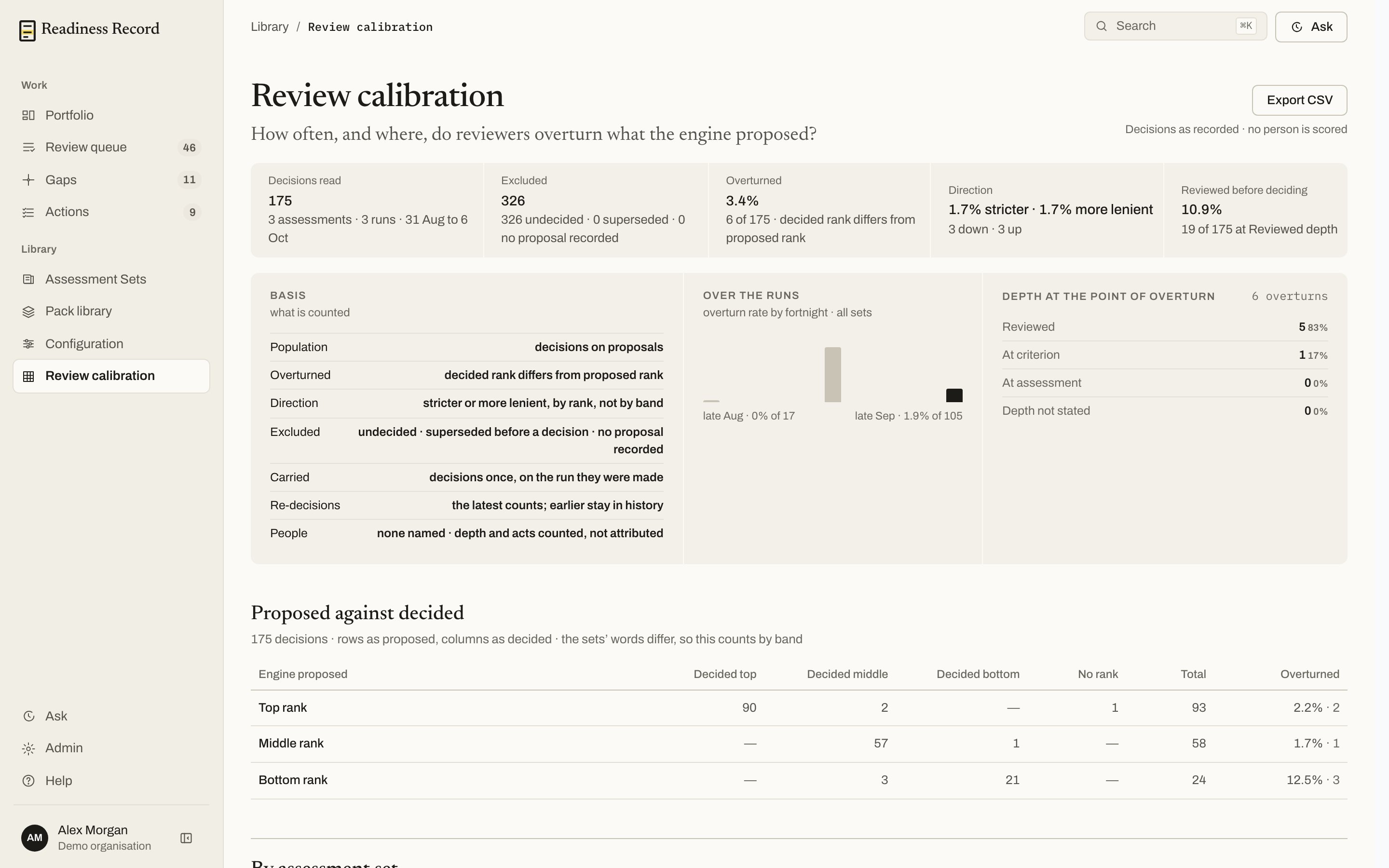
The headline figures
- Decisions read: how many decisions are counted, across how many assessments and runs, and the date range.
- Excluded: decisions left out because they are undecided, were superseded before a decision, or have no proposal recorded.
- Overturned: the share of decisions where the decided rank differs from the proposed rank.
- Direction: of those, how many were stricter and how many more lenient.
- Reviewed before deciding: the share of decisions made at Reviewed depth.
What is behind them
- Basis sets out exactly what is counted: the population, what counts as an overturn, how direction is judged, what is excluded, how carried decisions and re-decisions are treated, and that people are not named.
- Over the runs charts the overturn rate by fortnight, across all sets.
- Depth at the point of overturn shows how deeply the overturned findings were read.
- Proposed against decided is a table with the engine’s proposals as rows and the decisions as columns, counted by top, middle and bottom rank, because each set uses its own words.
- By assessment set gives the same figures per set. A set with fewer than 200 decisions is shown but not compared.
- Where overturns cluster lists criteria overturned on three or more decisions, and Most challenged the ten criteria challenged most often in review.
What’s next
- Configuration: scoring and strictness for your organisation